
First, I need to explain the title of my columns, that started some time ago when I served on the SEG Board as Vice-President, and each board member had to write an article for ‘The President’s Page.” I gave each of my 5 kids a copy of a book I was delighted to read, The Curmudgeon’s Guide to Getting Ahead, by Charles Murray, fatherly advice to young people who enter the workforce. I identified with the Curmudgeon, hence the title of my columns. Murray’s book started as postings on the internal website of the American Enterprise Institute where he works, with tips for entry level staff and interns such as:
- Excise the word “like” from your spoken English.
- Don’t suck up, meaning don’t flatter your supervisors.
- Stop “reaching out” and “sharing.”
- Rid yourself of piercings, tattoos, and weird hair colors.
- Make strong language count.
As a father I thought all of this was good, solid advice.
With the Curmudgeon in mind, I have a few comments to make about our life as researchers, pushing the leading edge of technology in our industries. I think one of the very important technologies in the past decade that John Sherwood pioneered is Beam Technology: Fast Beam Migration, Gaussian Beam Migration and Beam Tomography. Saudi Aramco just published an article in the August issue of The Leading Edge (TLE) describing the use of Fast Beam Migration combined with Beam Tomography for track processing, to obtain a depth stack and high-resolution velocity mode in three days after acquisition. I think that is very impressive, and I believe no other company in the world can match that speed. From the paper:
In terms of fast turnaround time, the following indicative field productivity metrics were achieved: for a partial block of acquisition 100 km2, using 38,000 recording channels, 24 vibrators were utilized, producing an average of 50,000 sweeps per 24-hour day of operations and a duration of three days recording 30 million traces per square kilometer.
Moreover, it took three days for fast-track processing, including FBM tomography producing image gathers, of this partial volume using 200 CPU nodes (dual 20 cores, 384 GB RAM per node). Therefore, in six days we have acquired and processed 100 km2 generating a multiplicity of velocity-depth models and their corresponding depth images and associated image gathers while the seismic crew was still acquiring data in the vicinity (Tsingas et al., 2020).
I recently gave a one-day class on Advanced Depth Imaging, part of the Geophysical Society of Houston (GSH) in-person Geophysics Academy and had to explain Smart Migrations (Beams) vs. Dumb Migrations (Kirchhoff or RTM). My analogy was imagining you are a soldier in a trench, shooting at the enemy. In Kirchhoff migration you don’t know where the enemy is so you shoot 180 degrees, while in Smart Migrations, you measure the dip and azimuth of the incoming fire and shoot back at the location of the enemy. Here is my class slide explaining how not to waste bullets in migration:
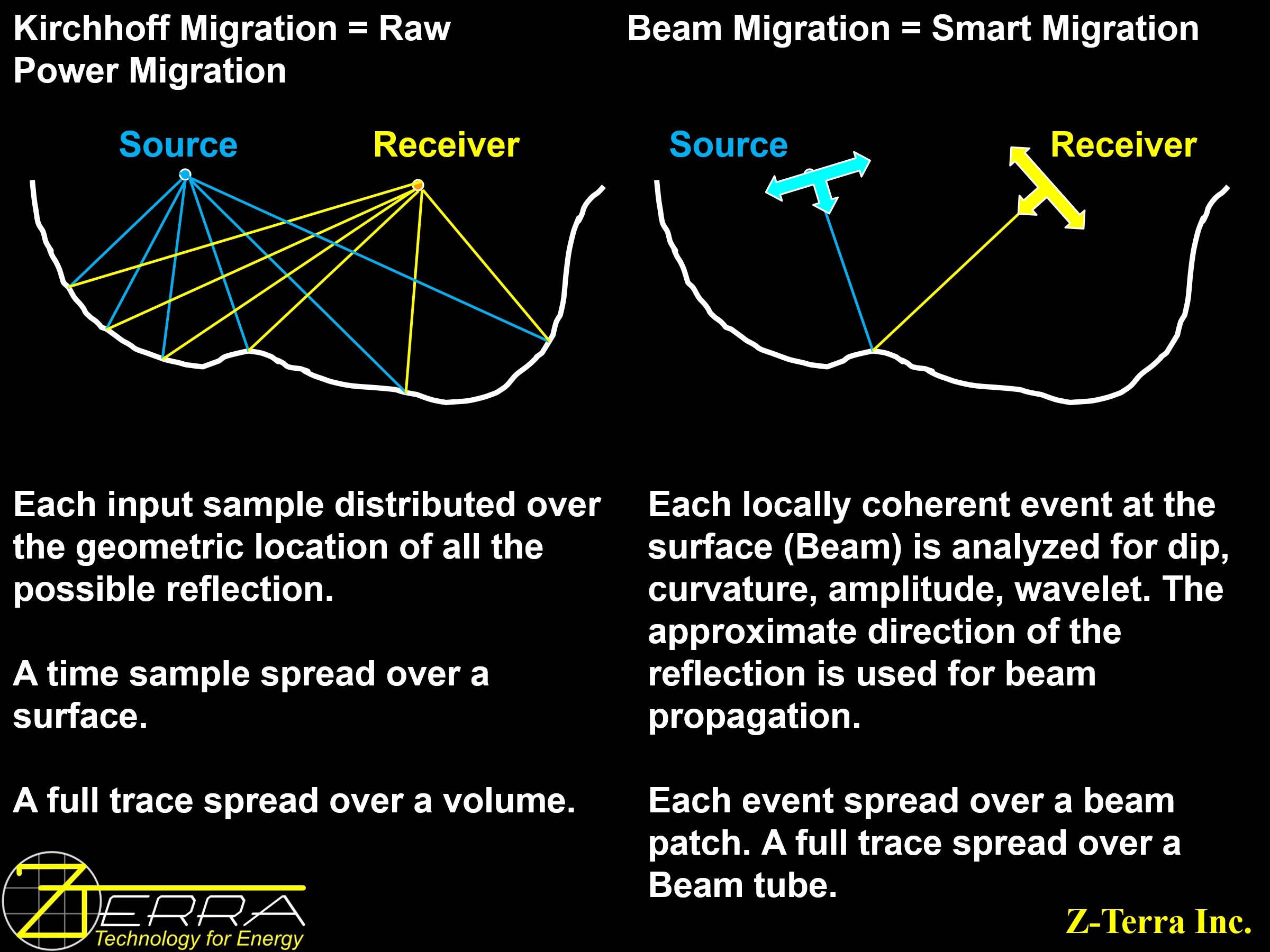
In my classification Beam Migrations are a subset of Smart Migrations, a class of algorithms that use information in the prestack input data to guide the migration operator, in contrast with Brute Force Migrations (or Dumb Migrations) such as Kirchhoff or RTM that make the assumption that every point in the subsurface is a diffractor, do not use the stack information available and make no a priori assumptions about the migrated image structure. There are some hybrid algorithms that use the dips from the stack to constrain the aperture, that do not fit neatly in my classification, but the helicopter view still stands.
The other application for Beam Migration is to obtain Full Waveform Inversion (FWI) like velocity models with 10-15 m lateral resolution, 100 times faster than standard FWI, which makes the technology usable by smaller companies that cannot afford 100,000 CPUs, but that will be in my next column.
References: From field to office – A fast-track beam depth migration with tomography updates applied to blended data, Authors: Ali Alzayer, Constantine Tsingas, Nick Tanushev, Mihai Popovici, and Mohammed Almubarak, The

Leave a Reply